
Who is the SVGW?
Drinking water in Switzerland: quality, standards and a critical look at the Swiss Technical and Scientific Association for Gas and Water

In Switzerland, the SVGW (Swiss Gas and Water Industry Association) stands for quality, safety and technical standards in the field of drinking water supply. For many, the SVGW is the measure of all things, but only a few people are aware of this: The association's guidelines are not a legal obligation, but technical recommendations. Nevertheless, in practice we see how a recommendation becomes a de facto obligation. Those who do not comply with the SVGW guidelines are often at a disadvantage, even if alternative solutions exist that are proven to work and serve to protect our drinking water.
For example, inquiries from interested parties and manufacturers, such as in the area of modern water filter solutions in Switzerland, have repeatedly been rejected by the SVGW with the argument that there is no need to use additional filters, even though PFAS, TFAS and other pollutants have now been detected in groundwater across the country. The picture is also one-sided when it comes to water softening: almost exclusively salt systems are recommended, while innovative alternatives such as salt-free water treatment systems are hardly considered.
This attitude raises questions, both with regard to the independence of recommendations and with regard to the handling of drinking water innovations and genuine alternatives to the SVGW system.
Our experience with the SVGW: radio silence instead of progress?
At Evodrop, we focus on proven quality, innovation and transparency. Our water treatment systems have been tested in independent, accredited laboratories according to international standards, scientifically validated and protected by patents. The growing number of satisfied customers from all over Switzerland confirms that drinking water innovation is possible, even beyond the classic SVGW guidelines.
Nevertheless, in our attempts to enter into dialog with SVGW Switzerland, we regularly come up against walls instead of openness. Our last official inquiry went unanswered without comment. No exchange, no queries, no statement. This was not about polemics, but about factual questions on the recognition of new technologies in water treatment.
This systematic rejection raises important questions for us:
- How innovation-friendly is the SVGW really?
- What interests play a role when forward-looking solutions are ignored or marginalized?
- And what does this mean for water protection in Switzerland if modern technologies are excluded without objective testing?
- Real quality needs open discourse. We are ready - but is everyone?
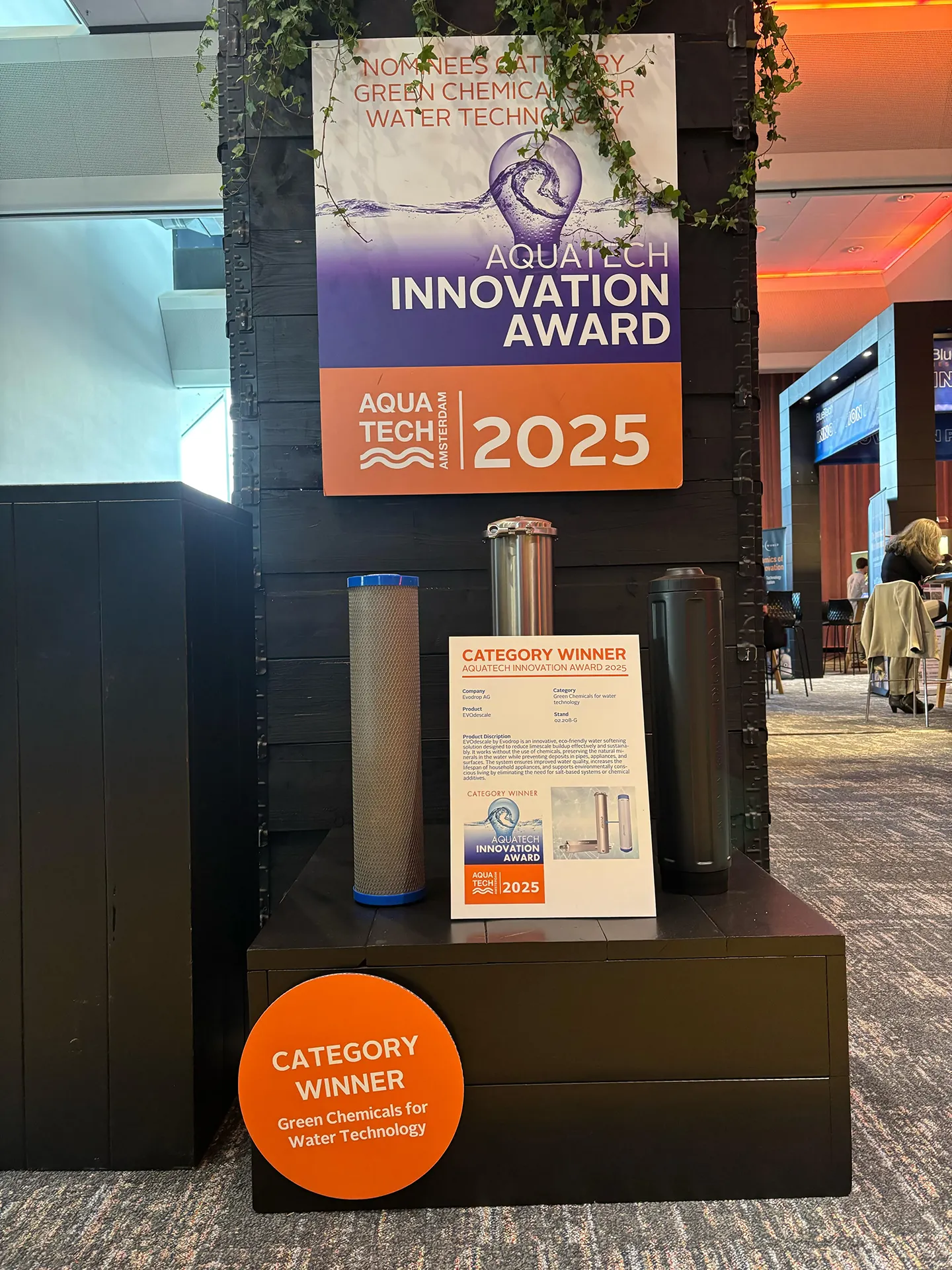
Evodrop's descaling system won this year's Innovation Award at AquaTech in Amsterdam 2025.
SVGW approval - not a legal requirement
In discussions with plumbers, local authorities or building owners, we repeatedly find that many assume that SVGW approval is mandatory in order to use a product in the field of drinking water treatment. However, this assumption is wrong.
In fact, there is no legal obligation that only SVGW-tested products may be used. The guidelines of the Swiss Gas and Water Industry Association (SVGW) are not generally binding standards, but recommendations of a private law nature - without direct legal force. This is also confirmed by the SVGW itself in an official article:
Water suppliers, municipalities and homeowners therefore have the freedom to use other tested technologies - as long as the applicable hygiene and safety regulations are complied with. This opens up scope for genuine alternatives to SVGW-compliant products, such as modern and environmentally friendly water filter solutions in Switzerland, such as those offered by Evodrop.
It is time to clear up this misunderstanding - for more freedom of innovation in Swiss drinking water protection.
What this means for you
If you opt for an innovative water treatment solution that is not listed by the SVGW, this does not mean that you are breaking the law. Rather, it shows that you are prepared to break new ground - provided you rely on demonstrably safe technologies, scientifically sound quality and products that have proven themselves in everyday use.
Drinking water protection in Switzerland does not necessarily have to mean only adhering to traditional structures. It can also mean being open to tested innovations that make a real contribution to sustainable water treatment - in the interests of your health and the environment.
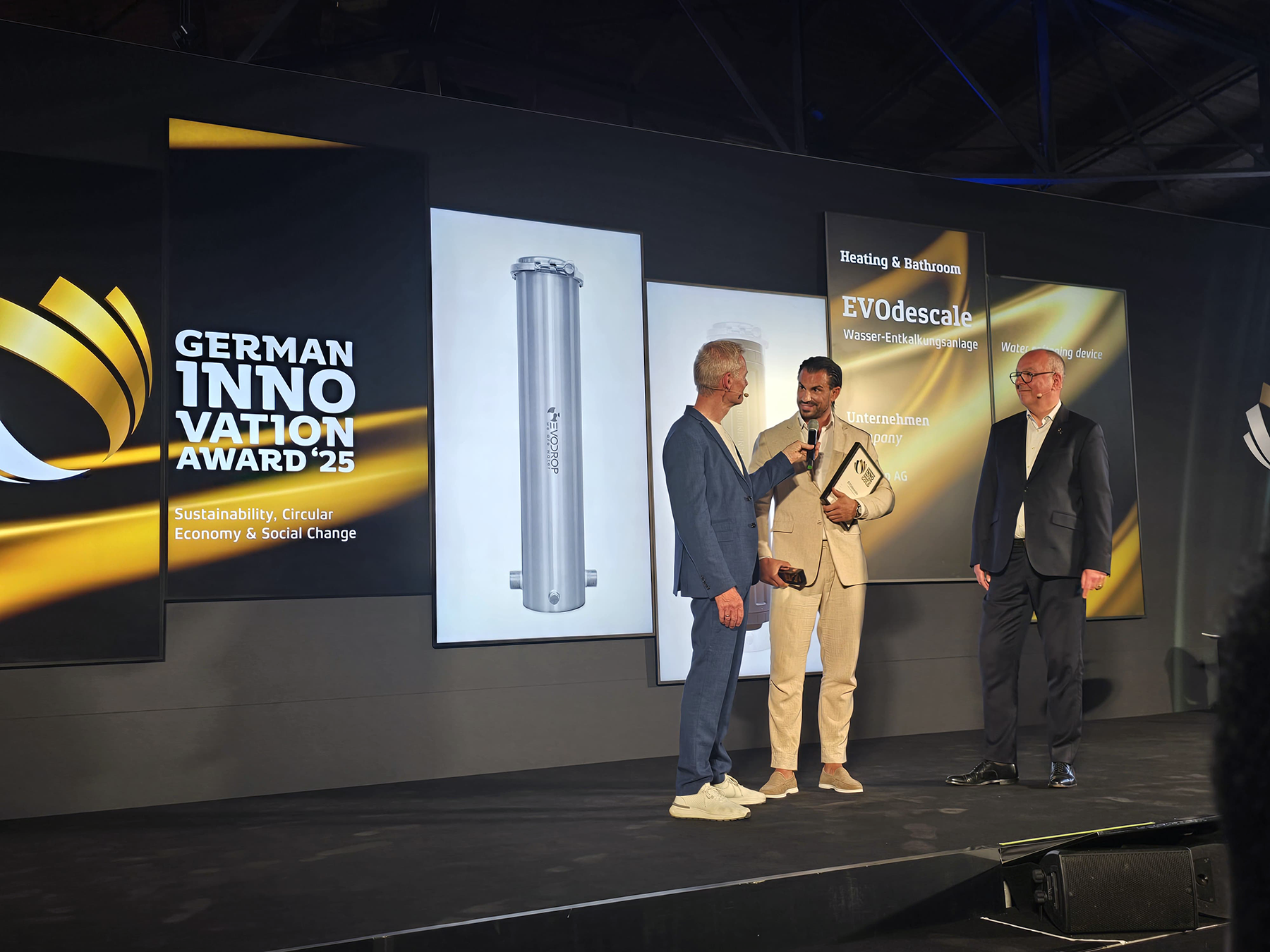
Why we are making this public
Because we have had enough of progress being slowed down. Because we are convinced that innovation needs transparency. And because the future of our drinking water must not fail because of old ways of thinking.
Evodrop stands for a new generation of water filters in Switzerland - technology-driven, scientifically tested and ready for a world in which sustainability and quality go hand in hand.
Have you had similar experiences?
We don't just want to sell products - we want to help shape change. That's why we invite installers, municipalities, planners and private individuals to enter into dialog with us.
Share your experiences with us - whether positive or critical. Let's work together on an open and future-oriented water landscape.
Because clean, safe drinking water is not a question of the past - it is a question of the future.
The SVGW no longer certifies drinking water post-treatment devices
An official decision by SVGW Switzerland provides clarity - and criticism at the same time:
The association has decided to no longer certify drinking water post-treatment devices in buildings.
The reasoning: According to the SVGW, drinking water in Switzerland is already of sufficiently high quality and additional treatment is not necessary. Exceptions only apply to devices that serve to protect the installations, such as mechanical pre-filters or classic softening systems with salt.
Those affected by this decision include:
- Reverse osmosis systems
- Activated charcoal filter (also built-in)
- Lime converter
- Devices for energization, levitation or ritual water treatment
- Devices for water revitalization or ionization
According to the SVGW, the effectiveness of many of these systems cannot be reliably verified. There is even a risk that incorrect use or inadequate maintenance could affect water quality. Although existing SVGW certificates will remain valid until 2020 at the latest, new certification orders will no longer be accepted.
For many manufacturers of innovative technologies - including Evodrop - this decision raises key questions:
What does this exclusion mean for demonstrably functioning, modern water treatment systems in Switzerland?
And: Does this attitude really serve consumer protection - or is innovation being systematically thwarted here?
Relevant facts about the SVGW: reality instead of myth
Practice clearly shows that even major market players do not rely exclusively on SVGW-certified products - and yet their systems are in use throughout Switzerland.
SVGW certification is associated with ongoing costs. Approval must be renewed every five years, which means both administrative work and a financial burden for manufacturers. This explains why many companies consciously decide against it - without sacrificing quality.
Conclusion: The SVGW is not the law
It must be made clear once again: The SVGW is an association. Not a legislator.
Its recommendations are not coercive, but technical guidelines of a private law nature. Anyone who opts for high-quality alternatives is not acting illegally - but in an entrepreneurial, responsible and future-oriented manner.
Frequently asked questions about SVGW and EVODROP
Is SVGW certification required by law in order to use water treatment systems in Switzerland?
No, SVGW certification is not a legal obligation. It is merely a technical recommendation from the SVGW association, which is not legally binding. Municipalities and water suppliers may make their own decisions as long as the general safety and hygiene regulations are complied with.
Why does EVODROP consciously advocate transparency vis-à-vis the SVGW?
Evodrop is convinced that innovation and progress in the drinking water sector must not be blocked by traditional structures or private associations. Our aim is to offer state-of-the-art technologies based on scientific studies and the highest international standards - independent of non-transparent certification procedures.
How has the effectiveness of EVODROP descaling been proven?
EVODROP's descaling performance was tested in the accredited German DVGW laboratory in accordance with worksheet W512. The technology achieved the top score of 1 with 100% descaling.
What independent proof of quality does EVODROP have if it is not SVGW-certified?
Evodrop products have been successfully tested by renowned institutions, including the US FDA, European MOCA, ROHS and SGS (the world's largest testing company). We therefore offer the highest quality assurance and international conformity.
Are there any other well-known providers in Switzerland that also do not have full SVGW certification?
Yes, for example, Meier Tobler sells limescale protection devices without SVGW certification, and companies such as BRITA or Burkhalter AG also sell their products in Switzerland without full SVGW approval. This shows that a lack of SVGW certification in no way reduces the quality or permissibility of a product.
Salt systems vs. alternative descaling with EVODROP
Why doesn't EVODROP use traditional salt systems for descaling?
Salt systems replace vital minerals such as calcium and magnesium with sodium ions. This makes the drinking water richer in sodium, which can be detrimental to health under certain circumstances. EVODROP, on the other hand, decalcifies with an innovative malic acid technology that retains the minerals in the water in an organically bound form.
Are salt systems safe for health?
No, numerous studies and reports warn of health risks. The Thurgau Cantonal Laboratory confirms that too much sodium in water can increase blood pressure and promote corrosion in water pipes. Salt systems are already banned in many US states due to the environmental and health risks.
How does decalcification with malic acid work with EVODROP?
The EVODROP technology uses malic acid to bind and filter out unwanted carbonate ions (calcifiers). The important minerals remain in the water and are even converted into a more organically available form.
Does EVODROP change the water hardness?
No, the water hardness is retained as only the limescale (carbonate ions) is removed. The water remains rich in minerals and is not enriched with sodium, as is the case with classic softening systems.
What are the advantages of EVODROP descaling compared to salt systems?
- No sodium enrichment in drinking water
- Preservation of important minerals (calcium, magnesium)
- No environmental impact from regenerating salts
- No need for regular re-salting and maintenance work
- Sustainable technology with scientific proof of effectiveness


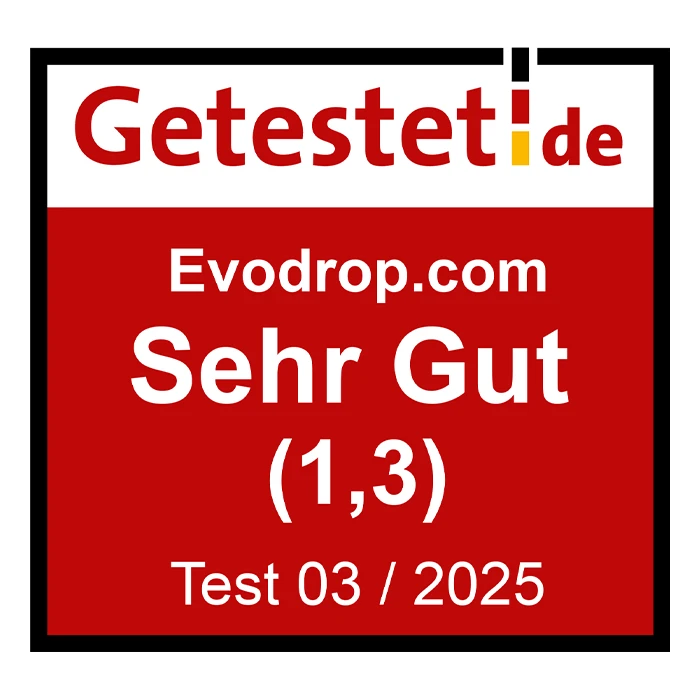
Evodrop.com in the individual test at getestet.de
How does Evodrop perform in the areas of website, performance and service? The renowned seal of approval "getestet.de" took a close look at Evodrop's concept, website and customer service.