

Pollutants in the water
Safety and purity with every drop:
Because reduction is not enough, Evodrop filters pollutants effectively and completely. What are the differences in the technologies?
Safety and purity with every drop:
Evodrop and the promise of pure water
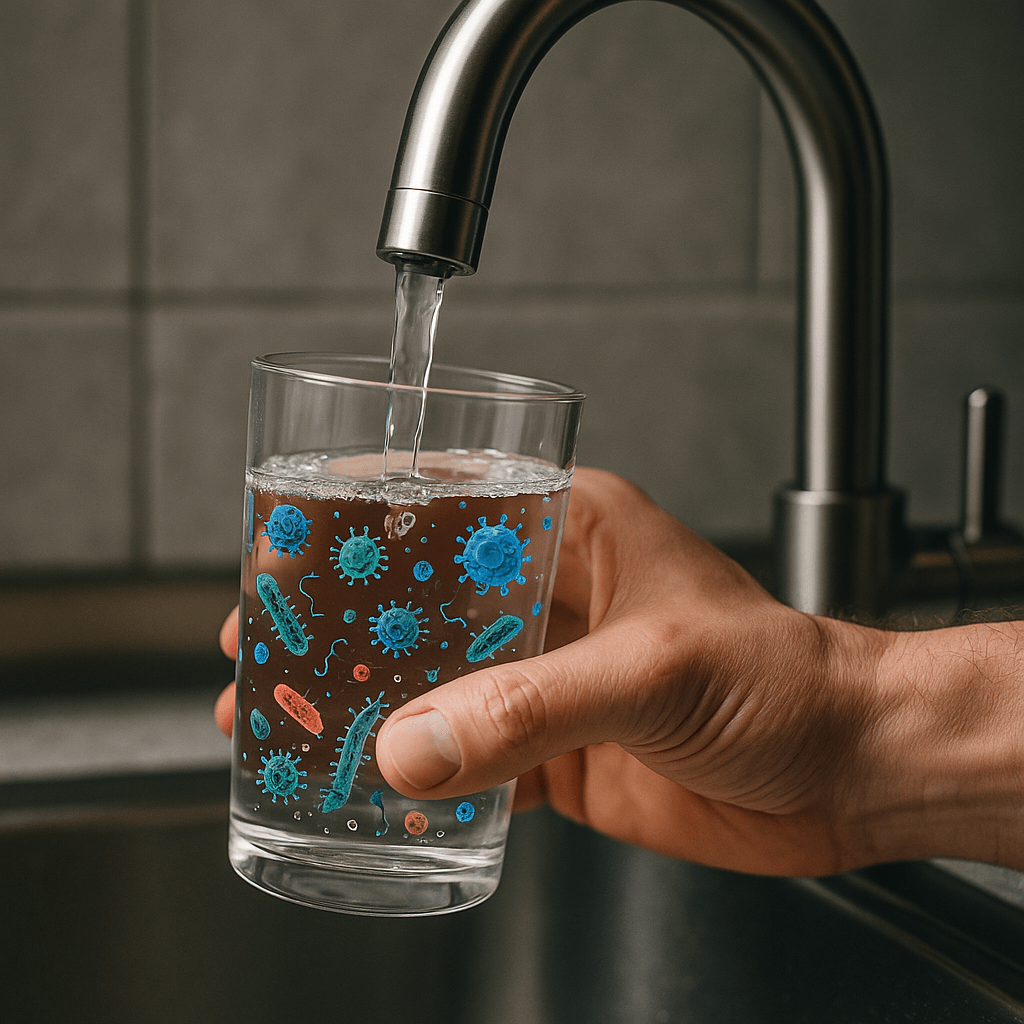
Water is the basis of all life. Whether for drinking, cooking or washing, the quality of the water we use every day has a direct impact on our health and well-being. However, the purity of our water is threatened by a variety of pollutants, which can be of both natural and anthropogenic origin. From industrial waste to agricultural contamination and outdated water infrastructures, the risks are manifold and require advanced water treatment solutions.
Why is water quality so important?
Clean and safe drinking water is crucial to avoid a variety of health problems. Contaminants in water can cause allergic reactions, skin irritations, gastrointestinal illnesses and even more serious long-term effects such as neurological disorders and cancer. Ensuring water quality is therefore not only a matter of health, but also of personal comfort and quality of life.
The threat posed by pollutants in water
Pollutants such as heavy metals, organic chemicals and microorganisms can enter our water supply in a variety of ways. Industrial waste, faulty wastewater treatment plants, natural sources and agricultural runoff all contribute to potentially harmful substances contaminating our water. Identifying and eliminating these pollutants is critical to ensuring water safety.
As a leading provider of water treatment systems, Evodrop offers an effective solution to the challenges of water purification. Our technology, backed by extensive research and innovative patents, efficiently removes a wide range of contaminants from water. With Evodrop, you not only get clean and safe water, but also the certainty that you are actively helping to protect your health and the environment.
Revolutionary water softening technology from Evodrop: efficiency without salt
At Evodrop, we understand the challenges that limescale in water can present, from calcified household appliances leading to increased energy costs to shortened lifespan of pipes and fittings. Our answer is an innovative, environmentally friendly technology for limescale-free water that is not only sustainable, but also efficient and scientifically proven.
What does "softening without salt" mean?
Traditional water softening often uses salt-based ion exchangers that swap calcium and magnesium ions for sodium ions. However, this can increase the sodium content in the water and cause environmental pollution through the use of salt and the associated amount of waste water.
Evodrop takes a different approach:
- Ion screen technology (filtration): Our systems use advanced filter technologies to effectively remove limescale particles from the water without changing the chemical composition of the water. This is made possible by the malic acid granules in our cartridges, which bind and remove limescale.
- Advantages of salt-free technology: Preservation of minerals: In contrast to conventional systems, our technology does not remove important minerals such as calcium and magnesium. These minerals are essential for human health and are retained in the water.
- Environmentally friendly: Since no salt is used, there is no salt waste or deposits that could pollute the environment. In addition, our systems do not produce any additional waste water.
- Simplicity and cost-effectiveness in maintenance: Maintenance of our systems is simple and cost-effective, as it only involves replacing the filter medium. This can be done without special tools or expertise and saves significantly on operating costs compared to traditional systems.


Discover the difference!
Convince yourself of the power of our limescale protection with a simple self-test. All you need is a kettle or a pan. Maximum limescale protection, no change in taste.
The test kits are only sent to Germany, Switzerland or Austria

System comparison
| Criterion | Activated carbon block | Salt plant | Reverse osmosis | EVODROP active diaphragm |
|---|---|---|---|---|
| Removal of PFAS & TFAS | ❌ Insufficient | ❌ no effect | ✅ yes | ✅ yes (proven) |
| Removal of heavy metals | ❌ Insufficient | ❌ no | ✅ yes | ✅ yes |
| Removal of microplastics | ❌ Insufficient | ❌ no | ✅ yes | ✅ yes |
| Minerals remain contained? | ✅ are retained | ❌ are partially replaced by sodium | ❌ completely removed | ✅ are retained |
| Water consumption | ✅ No waste water | ❌ high (up to 150 L/reg.) | ❌ very high (1:1) | ✅ No waste water |
| Risk of contamination | ❌ high | ❌ Medium with insufficient maintenance | ❌ medium | ✅ No contamination (antibacterial alloy) |
| Maintenance effort | ❌ medium (min. every 6 months) | ❌ Regular & elaborate | ❌medium (filter change every 6-12 months) | ✅ 1x per year without tools |
| Limescale protection | ❌ no | ✅ Yes, but with sodium | ✅ yes | ✅ Yes (optionally with malic acid) |
| Environmental impact | ✅ low | ❌ Salt, exchange resin, electricity & waste water | ❌ medium to high | ✅ Environmentally friendly & sustainable |
| Durability & material quality | ❌ limited | ❌ Plastic, hazardous waste & exchange resin | ❌ approx. 5 years | Up to 20 years manufacturer's warranty |
| Laboratory-tested effectiveness | ✅ mostly | ✅ mostly | ✅ yes | ✅ 2 independent CH laboratories & 4 international laboratories |
Popular, but with weaknesses: Activated charcoal filters
Activated carbon filters are among the best-known water filter systems. However, they are only effective against certain types of impurities, such as chlorine, odors, taste and some organic substances.
They cannot completely remove nanoscale pollutants such as heavy metals (e.g. lead, mercury), nitrates, microplastics or viruses. Such filters are available as simple jug solutions or as permanently installed systems under the sink. It is important to replace the filter cartridge regularly, as it only remains germ-free for a short time.
The disadvantages of activated carbon filters:
- Activated charcoal filters offer no protection against bacteria, viruses or other microorganisms as they are not sterile. There is even a risk of bacteria colonizing the charcoal. All water carafes have failed Stiftung Warentest due to contamination.
- Activated carbon filters have a limited service life and must be replaced regularly as their adsorption capacity is exhausted. Regular filter maintenance is therefore essential.
- If the filter is not changed in good time, the filtered pollutants can get back into the water (desorption). If the water is heavily contaminated, the filter can quickly become clogged, which significantly reduces efficiency and reduces the water flow.
- Activated carbon filters can only insufficiently remove PFAS (per- and polyfluorinated chemicals) and other persistent pollutants that are frequently found in groundwater.
- Low filtration quality (maximum 0.1 micrometers).
- Flow velocity and water pressure are greatly reduced.
microfiltration the water treatment of Evodrop:
In contrast to conventional activated carbon filters based on powder or granulate, the EVOadsorb has a membrane-like structure. This filter is ten times more absorbent and offers constant flow rates without any significant pressure loss. The highly porous surface of the adsorbent material is able to capture and retain the foreign substances in the water. Compared to conventional competitor products, all pollutants are retained over the entire service life and are no longer released into the water.
The better water treatment technology from EVODROP
Evodrop has developed a technology that far outperforms activated carbon filters. The technology is based on a membrane-like structure that:
- is 10 to 15 times more absorbent and efficiently binds pollutants.
- There is no risk of channel formation, which ensures consistently high filter quality.
- With a filter depth of 0.002 micrometers, pollutants such as microplastics, pesticides, heavy metals and even PFAS are removed from the water.
- No significant pressure loss.
- The patented antibacterial alloy is embedded in each layer and is not released into the water.
Highly pure, but inefficient: reverse osmosis
The membranes come exclusively from China and the systems are usually of inferior quality so that good values can be achieved at the beginning but the filter performance decreases rapidly after just a few weeks. The membranes also have to be replaced regularly due to clogging and contamination.
Evodrop's solution: Orbital Osmosis
With Orbital Osmosis, Evodrop has developed a technology that eliminates all the disadvantages of conventional reverse osmosis systems.
Both the technology and the term itself are protected and set new standards in the filter industry.
Our membrane efficiently filters all pollutants out of the water - proven in two independent Swiss laboratories - while retaining minerals.
- Water consumption: Only 1 liter of tap water per liter of drinking water.
- Long service life: replace the membrane only after 10,000 liters.
- Uncompromising filtration of all pollutants from the water over the entire service life of the membranes
The organic advantage: malic acid
A key aspect of our technology is the use of malic acid, a natural component of many fruits, especially apples. Malic acid is an important intermediate in the metabolism of living organisms and plants and has several advantages:
- Neutral and tasteless: It does not change the taste of the water and has no harmful effects on the human body.
- Improving water quality: Studies show that malic acid not only effectively removes limescale, but also makes the water softer and more digestible, similar to natural water, which is constantly in motion.
By utilizing these advanced technologies, Evodrop provides an effective and environmentally friendly water softening solution that ensures your water is free of harmful limescale and other impurities while remaining rich in vital minerals.

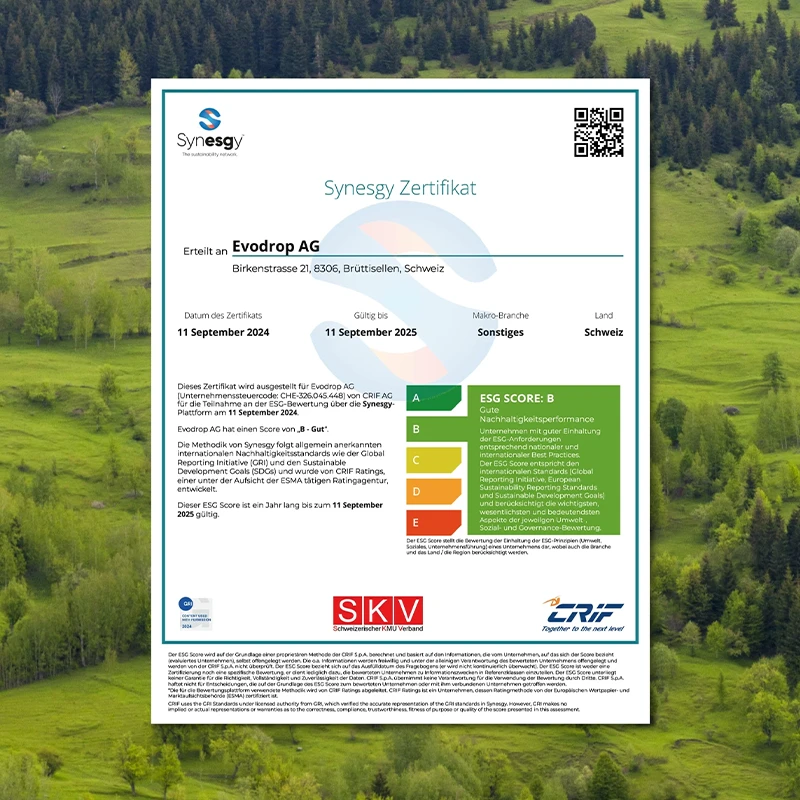
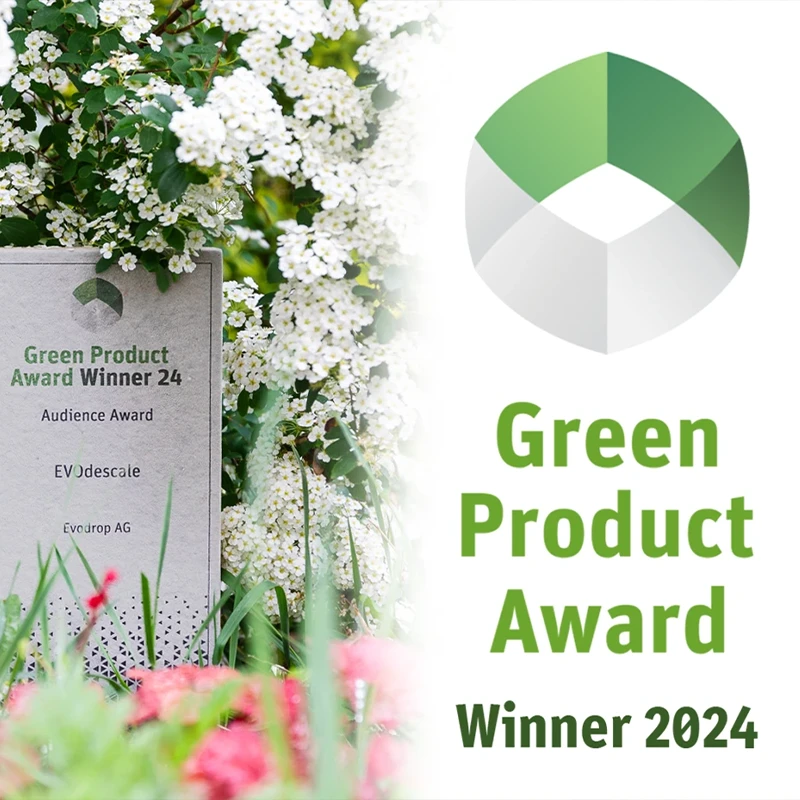
Find out more about EVODROP's certified and award-winning salt-free descaling!








Frequently asked questions about pollutants in water
What pollutants are in the water?
What pollutants are there in the water?
The most common pollutants include:
- Heavy metals: lead, mercury and arsenic, which can come from industrial processes, obsolete pipelines and natural sources.
- Organic chemicals: These include pesticides, herbicides and solvents that enter the water from agricultural use and industrial wastewater.
- Microorganisms: Bacteria, viruses and protozoa that can cause disease.
Which substances can harm drinking water?
What kind of pollutants are there?
What substances are in drinking water?
Why Evodrop is the right and best solution?
Your dream water in just a few steps
FROM CONSULTING TO INSTALLATION - EVERYTHING FROM A SINGLE SOURCE



Evodrop.com in the individual test at getestet.de
How does Evodrop perform in the areas of website, performance and service? The renowned seal of approval "getestet.de" took a close look at Evodrop's concept, website and customer service.

